How to Understand Bill Gates's AI Warning About Catastrophic Risk and Weak Regulation
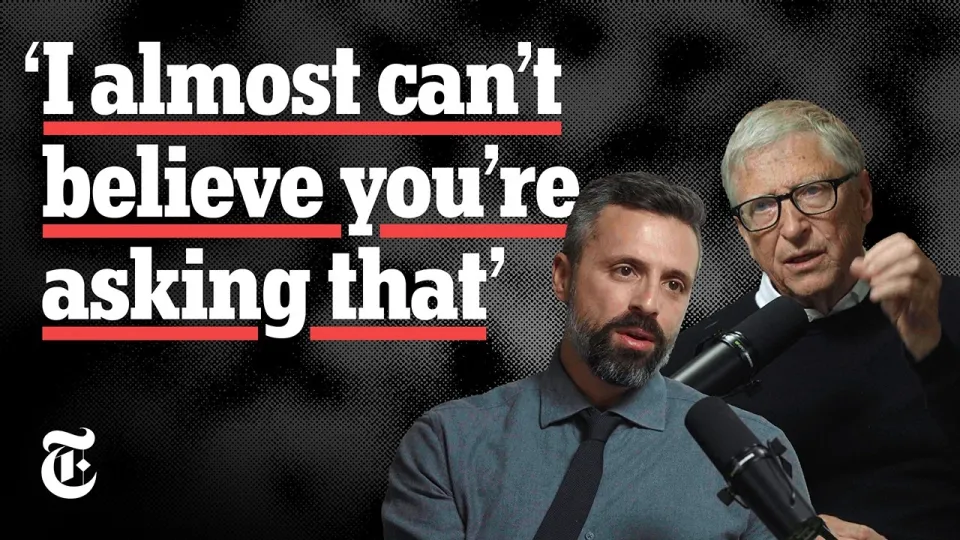
Video: Bill Gates: A.I. ‘Makes Nuclear Weapons Look Like Nothing’ | The Ezra Klein Show
You can order the same kind of articles for your own video to boost it on YouTube and Google. Just message the Telegram bot @sat_sit_bot. Articles with your video embedded are written and posted by the bot itself — on popular topical sites (no ads). Your first 50 articles are free.
To understand Bill Gates's AI warning, separate it into three claims: the technology is more dangerous than nuclear weapons, the industry cannot police itself, and governments must set hard thresholds before cyber or bio capabilities cross into catastrophe. Gates made the case in a conversation with Ezra Klein, and the full transcript is available through The Ezra Klein Show episode page on NYT Opinion. The practical takeaway for readers, policymakers and employees is that AI risk is now a governance problem with deadlines, not a philosophical debate.
What Gates actually said about AI risk
Gates's central claim is that AI is the most dangerous thing humans have ever gone near, and that the comparison to nuclear weapons understates the problem. That framing matters because nuclear risk is the benchmark most institutions already use for existential threats: treaties, inspections, command-and-control rules and decades of deterrence theory. Gates argues AI escapes all of those containers because it is software, it spreads instantly, and the same model that helps design a drug can help design a pathogen.
He also drew a line between two kinds of harm. The first is deliberate misuse by states or terrorists, especially in cyber and biology. The second is economic disruption that arrives faster than institutions can retrain workers or build new safety nets. In the interview he was visibly more alarmed than in past appearances, and the audience noticed: several of the most-liked comments on the episode describe him as agitated and emotional, with one summarizing the exchange as Klein saying things are bad and Gates replying that they are much worse.
Why self-regulation fails, in Gates's account
The argument against industry self-regulation is simple: companies compete on speed, and safety spending loses that race. Gates called the idea that the AI industry can regulate itself "insane," and he was blunt about the legal alternative. When Klein raised litigation as a remedy, Gates's response, as viewers clipped it, was close to disbelief that anyone would answer a mass-casualty event with a lawsuit.
His reasoning runs in three steps:
- Liability arrives after harm, while AI-enabled attacks can cause damage at machine speed.
- Firms cannot credibly promise to slow down when rivals, including state-backed labs, keep shipping.
- Only governments can set thresholds, audit labs and impose penalties that survive a competitive market.
The comparison to other regulated industries is imperfect but useful. Aviation and pharmaceuticals accept pre-deployment testing because the cost of failure is visible and concentrated. AI harms are diffuse, delayed and often invisible until scale, which is exactly the profile that voluntary commitments handle worst.
The cyber and bio thresholds that should trigger action
Gates's most concrete proposal is threshold-based regulation rather than blanket rules. Instead of trying to license every model, governments would define capability lines that trigger mandatory review, disclosure or restriction. He points to two domains where the lines matter most.
- Cyber: models that can autonomously find and exploit vulnerabilities in critical infrastructure, from power grids to water systems, change the offense-defense balance. Gates expects catastrophic cyberattacks in the years ahead unless governments harden systems and set rules for model access.
- Bio: models that lower the barrier to designing dangerous pathogens are the sharper worry. Gates has spent two decades funding global health, and he treats bioterrorism as the scenario where a single failure could kill millions.
Thresholds are hard to write, because capabilities appear gradually and can be replicated in open models. But the alternative Gates describes is waiting for a disaster and then legislating in a panic, which historically produces rules aimed at the last attack rather than the next one.
The China race and why safety cannot mean stopping
Gates does not argue for a pause, and that distinguishes him from some AI safety advocates. He treats the race with China as a reason to move faster on safety rather than a reason to abandon it. If one country slows down unilaterally, the capability migrates; if both build guardrails, the race becomes safer without stopping.
This is the tension at the heart of the interview. Klein pushes toward the view that the situation is dire enough to justify restraint. Gates pushes back that restraint without coordination simply hands the advantage to actors with fewer scruples. The practical implication for policy is that international agreements on cyber and bio thresholds matter more than domestic licensing regimes, because pathogens and exploits do not respect borders.
Jobs, inequality and the case for taxing AI labor
Gates expects mass job loss, and he treats it as a design question rather than an inevitability. One idea he explores is a no-scarcity job market, where cheaper intelligence expands what societies can afford to do in care, education and public services. Another is taxing AI labor, so that gains from automation fund the transition instead of concentrating in a handful of firms.
He also raises the notion of "human reserved" jobs, roles where people deliberately keep humans in the loop for reasons of accountability or preference. And he flags a global equity problem: if AI tutoring and medical advice arrive first in rich countries, the gap widens, which is why his foundation made AI-driven inequality a new priority. The foundation is set to spend down around $200 billion over the next two decades, and Gates frames that money as a counterweight to a market that rewards whoever deploys fastest.
What the audience pushed back on
The most useful questions from viewers cluster around a few doubts. One is whether Gates is overstating the danger, given that he is also an investor in AI companies. Another is whether capitalism can correct itself, a point several commenters rejected by pointing to a century of industrial harms that required regulation rather than market discipline. A third is whether a lawsuit or a voluntary pledge could ever be proportionate to a mass-casualty event, which is the moment in the interview that circulated most widely.
A quieter theme is credibility: viewers noted that Gates disagreed with Klein without interrupting him, and that the show kept those tense exchanges in the edit. That matters for anyone trying to form a view, because the argument is stronger when the friction is visible rather than smoothed out.
Useful links
- Full transcript of the Bill Gates conversation on The Ezra Klein Show
- Book recommendations from guests of The Ezra Klein Show
The bottom line
Gates's message is that AI risk is a scheduling problem: the capabilities are arriving before the institutions that would govern them. His prescription is not a pause but threshold-based regulation in cyber and biology, international coordination, and tax and education policy that spreads the gains. Readers who want the full argument, including the exchanges on jobs, education and foreign aid, can read the transcript linked above. The conversation was produced by The Ezra Klein Show, and it is worth hearing in full rather than through clips.
Key takeaways
- Gates calls AI the most dangerous technology humans have approached, saying it makes nuclear weapons look like nothing.
- He rejects industry self-regulation as "insane" and argues lawsuits cannot answer a catastrophe that kills 100 million people.
- Gates names two hard thresholds for government action: cyberattacks and bioterrorism enabled by AI.
- He frames the AI race with China as a reason safety work must speed up, not slow down.
- The Gates Foundation is set to spend down around $200 billion over two decades, with AI-driven inequality as a new priority.
Questions & answers
Why does Bill Gates say AI makes nuclear weapons look like nothing?
Gates argues that nuclear risk is contained by treaties, inspections and deterrence, while AI is software that spreads instantly and lowers barriers to cyber and bio attacks. In his view the speed and accessibility of the technology make the comparison to nuclear weapons too generous.
What does Gates propose instead of self-regulation?
He wants governments to set capability thresholds, especially in cyber and biology, that trigger mandatory review or restriction. He rejects voluntary industry pledges and litigation as inadequate responses to mass-casualty risks.
Does Gates want to slow down AI development?
No. He treats the race with China as a reason to move faster on safety rather than to pause, arguing that unilateral slowdown shifts capability to less cautious actors. Coordination on thresholds matters more than stopping.
How does Gates connect AI to jobs and inequality?
He expects significant job disruption and discusses ideas such as taxing AI labor and expanding a no-scarcity job market in care and public services. He also warns that AI benefits will reach rich countries first, which is why his foundation made AI-driven inequality a priority.
Source: Bill Gates: A.I. ‘Makes Nuclear Weapons Look Like Nothing’ | The Ezra Klein Show · Markdown version